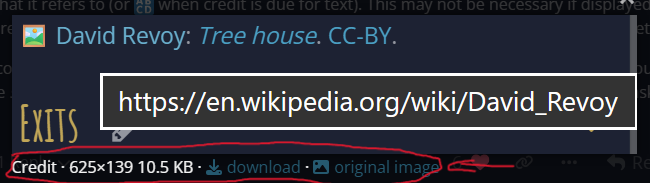
I’d like to suggest a feature mentioned in passing in a previous suggestion; image credits.
The Mucklet terms specify that credit should be given for other people’s content:
Respecting others’ rights
You may not provide content that infringes on someone elses [sic.] intellectual property. If you use an image, or add content based on someone elses work, make sure you have the rights to do so. And give credits where credit is due.
Currently I do this to the extent possible, and I have seen a few characters doing something similar, but overall there is a tendency to say “credit to the [unnamed] artist”, possibly with an offer to take it down. This isn’t fair to the artist or photographer concerned and not in line with the terms; and doesn’t clarify when a work is made by or for the character owner.
One reason for this may be that there is no default way to supply this credit. I suggest text input fields on image submission or perhaps as part of the room/character profile editor (though this would reinforce the already non-ideal “one image per profile” limit) for creator name, work name and license, with associated URL fields, all optional.
There might also be checkboxes for artist or commissioner. This way you could say it’s a commission and identify the artist, but not the work if it wasn’t public or didn’t want to out yourself as the player behind the character - or vice versa if the artist desired anonymity.
This would ideally replace what I currently use for credit, along the lines of:
--🖼️ [David Revoy](https://en.wikipedia.org/wiki/David_Revoy): _[Tree house](https://commons.wikimedia.org/wiki/File:2012-08-24_Tree-house_by-David-Revoy.jpg)_. [CC BY](https://creativecommons.org/licenses/by/4.0/deed.en).--
This renders as:  David Revoy: Tree house. CC BY.
Or in Mucklet:
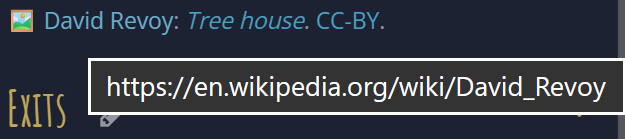
Because I put this at the bottom of the description I use an icon like or  to indicate what it refers to (or
  when credit is due for text). This may not be necessary if displayed directly beneath the image. (If space is low I just use “BY” for the license, or “BY-NC-SA”, etc.)
I could also see it as an info line beneath the expanded view on-click, although there should be some indication of credit on the default view too, if not a line of text then an icon/mask.